

Exosome biorevitalization

Exosome biorevitalization is a modern procedure in regenerative aesthetic medicine aimed at improving skin quality, density, elasticity, and natural radiance.
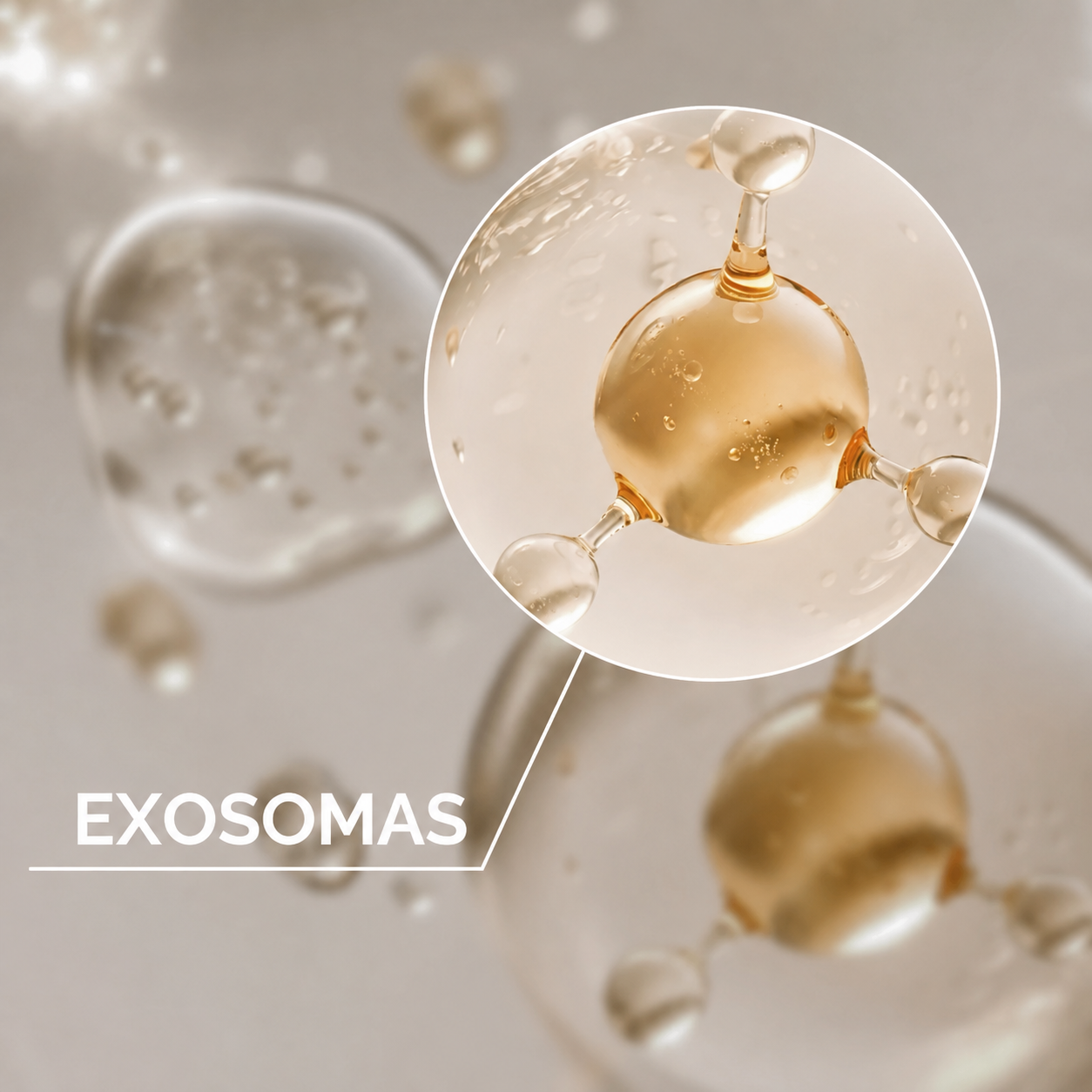
The technique is based on exosomes—microscopic particles that cells use to transmit biological signals to one another.
Exosomes can contain proteins, lipids, growth factors, and various types of RNA. Thanks to this, they are able to participate in a complex system of intercellular communication and influence tissue repair processes.
Unlike stem cell therapy, exosomes are not living cells. Their primary function is to transmit biological signals to skin cells.
How do exosomes work?
As we age, skin renewal processes gradually slow down. Fibroblasts become less active, the production of extracellular matrix components decreases, and the structure of collagen and elastin changes.
At the same time, solar radiation, stress, and other external factors contribute to the development of oxidative stress and accelerate the skin’s aging process.
Exosomes interact with skin cells and transmit biologically active signals to them.
Simply put, they act as microscopic “messengers” between cells, delivering information that can influence tissue repair and renewal processes.
Stimulation of fibroblasts
One of the main targets of regenerative therapy is fibroblasts.
These are the cells responsible for forming the structural framework of our skin.
They are the ones that produce:
- collagen—responsible for the skin’s density and strength;
- elastin—helps the skin maintain its elasticity;
- hyaluronic acid—which helps maintain tissue hydration;
- other components of the extracellular matrix.
Exosomal signals can influence fibroblast activity and the processes of extracellular matrix renewal.
As a result, the skin can gradually become firmer, smoother, and more elastic.
Supporting collagen and elastin synthesis
Collagen and elastin form a unique internal scaffold for the skin.
With age, the production of new collagen slows down, and existing fibers gradually become damaged and lose their proper structure.
Exosomal therapy is designed to support cellular processes involved in the formation and remodeling of dermal components.
This can help improve skin firmness and elasticity and reduce the appearance of minor age-related changes.
Exosomes are actively being studied due to their ability to participate in signaling pathways related to tissue regeneration.
They interact not only with fibroblasts but also with cells of the epidermis, the immune system, and blood vessels.
This creates a more favorable cellular microenvironment for the skin’s natural repair processes.
Therefore, exosomal technologies are of particular interest in programs aimed at improving skin condition following sun exposure, stress, and certain aesthetic procedures.
Chronic microinflammation is one of the factors contributing to premature skin aging.
It can contribute to collagen breakdown, increased skin sensitivity, and a slowdown in normal repair processes.
Certain exosomal signals have the ability to influence the activity of immune system cells and regulate inflammatory processes.
As a result, exosomal technologies are being studied as a potential way to create more favorable conditions for tissue repair.
Sunlight, environmental pollution, and natural metabolic processes lead to the formation of free radicals.
When their levels become too high, oxidative stress develops, which accelerates cell damage and collagen breakdown.
Exosomes are being studied for their ability to support the cells’ natural protective and regenerative mechanisms.
This is particularly beneficial for skin showing signs of photoaging, a dull complexion, and uneven texture.
Improving skin texture and quality
The effect of exosomes is not aimed at changing facial contours, but primarily at the quality of the skin itself.
After a course of treatments, the goal is a gradual improvement in:
How do the results develop?
Exosomal therapy does not work like a filler, so the effect should not be assessed immediately after the procedure.
Changes occur gradually as tissues naturally renew themselves.
At first
Patients may notice that their skin looks fresher and more hydrated.
Subsequently
The goal of the therapy becomes improving the skin’s texture, smoothness, and elasticity.
Exosomes — the “language of communication” between cells
The main idea behind the procedure can be explained very simply:
This is precisely why exosomal biorevitalization is considered a promising area of regenerative aesthetic medicine.
Its goal is not to alter the face, but to help the skin look fresher, smoother, firmer, more elastic, and naturally radiant.
